The display had gone dim and half the touch panel ignored us. He found moisture had got behind the fascia from the steam of the cooktop below and had corroded the ribbon. Cleaned, resealed, new ribbon, working properly.
Diagnostics
Four reasons an oven stops holding temperature
Uniform offset, overshoot and sag, slow preheat and long-bake heat loss are four different faults with four different parts behind them. Separating them before quoting is most of the job.
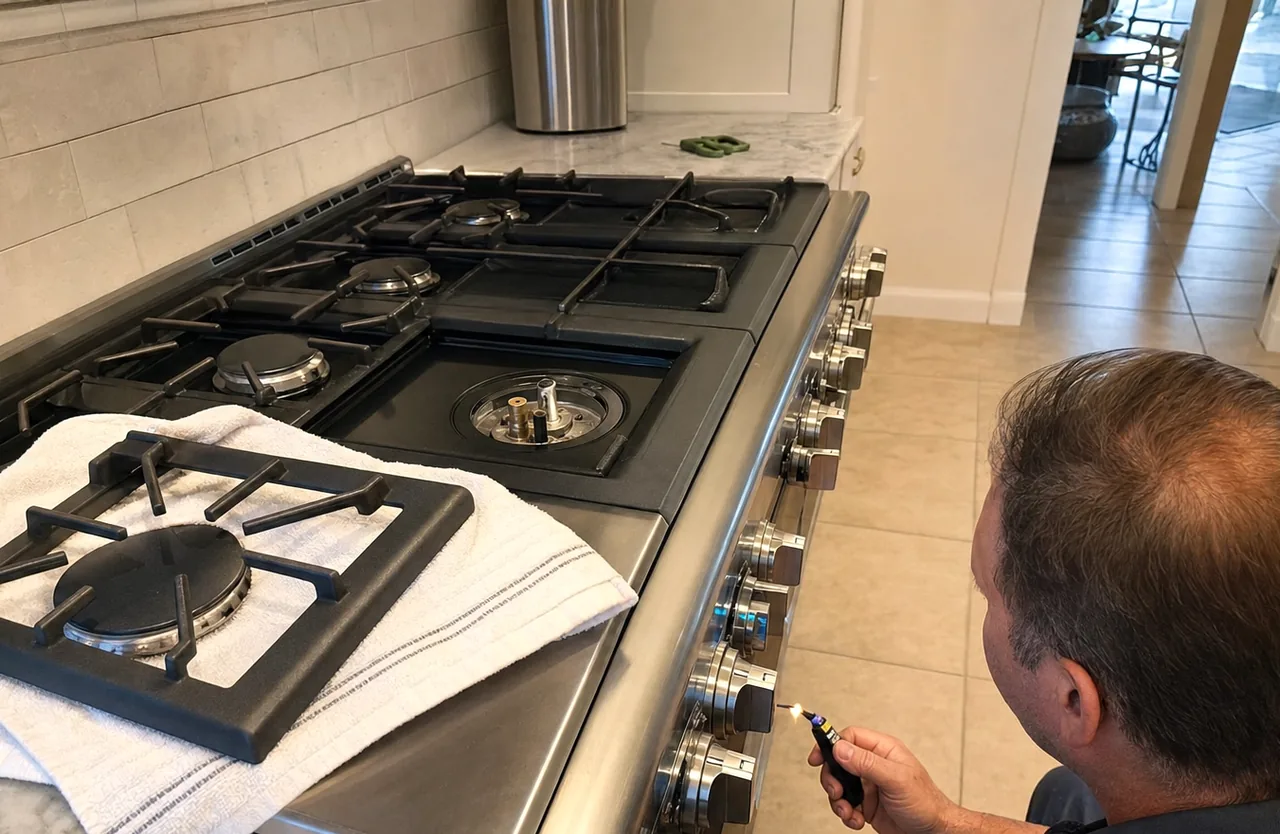
An oven that reads right and bakes wrong is a sensor or a calibration problem far more often than a failed element.
Article
Four reasons an oven stops holding temperature
Start with what the display means
The number on the front of the oven is what the control believes, derived from a resistance reading off one sensor in one spot in the cavity. It is not a measurement of your food’s environment and it was never meant to be.
So the first job on any temperature complaint is to stop arguing with the display and measure the cavity independently, over at least three full cycles, with the door shut and the oven loaded the way you actually use it. What comes back sorts the fault into one of four cases.
Case 1: uniform offset
The oven reads 350 and holds a steady 315, or a steady 380. The error is the same at every setpoint and stable across the whole cycle.
This is the sensor, nearly always. Oven temperature sensors are resistance devices with a known curve; a common type reads in the region of 1,080 ohms at room temperature. Measure it cold with the oven at ambient. A long way off the expected value and the control is being lied to consistently, which is exactly what a uniform offset looks like.
Small uniform errors can often be corrected with the oven’s own calibration offset. Large ones mean a sensor.
Case 2: overshoot and sag
The oven blows past setpoint on the way up, then falls short at the end of a long bake. The average might even look correct, which is why owners describe it as inconsistent rather than wrong.
This is a heat delivery problem, not a measurement problem. On an electric oven, look at the elements: one element open leaves the oven trying to hold temperature on the other, which changes the whole cycle shape. On a gas oven, look at the valve. A valve that opens late and then delivers full rate produces exactly this signature.
Case 3: slow preheat
Preheat that used to take twelve minutes now takes twenty-five, and everything else looks normal.
Check the bake element draw first. An element with a partially failed section still glows and still draws current, just less of it. On a double oven, check whether the second cavity is behaving the same way, because that separates an appliance-wide supply problem from a single element.
If the elements are fine, look at the door. A gasket that no longer seals at the top is a continuous heat leak, and preheat is where you notice it first.
Case 4: heat loss over a long bake
The oven reaches temperature normally and then cannot hold it for a two hour roast.
This is the door, most of the time. Take a strip of paper, shut it in the door at four points around the frame, and pull. Where it comes out with no resistance, the gasket is not sealing. Then check whether the door is square, because on a heavy professional door the usual cause of a bad seal is a hinge that has settled rather than a gasket that has worn.
Hinges go in as a pair. Replacing one twists the door and moves the problem to the other corner.
The self-clean question
Self-clean drives the cavity far above any cooking temperature and it finds every weak component in the oven. On a newer machine that is fine, it is what the cycle is for. On an oven over about fifteen years old it is a genuine risk to the thermal fuse, the thermal limit and the control board, and we see ovens that ran a clean cycle and never woke up.
If your oven is that age and it needs cleaning, clean it by hand. It is a bad afternoon rather than a dead oven.
What we do
We log the cavity with an independent probe over three cycles before quoting, measure sensor resistance cold, check element draw on both bake and broil, and put a level on the appliance. That sequence costs one diagnostic visit and it stops customers buying the wrong part, which is the expensive mistake in oven work.
Questions
Follow-ups
Can I just recalibrate the oven myself?
Many ovens have an offset adjustment and it is legitimate to use it for a small uniform error. It is the wrong tool for an oven that overshoots and sags, because that is not a calibration problem and the offset will make one part of the cycle worse.
Is an oven thermometer from the supermarket good enough?
For a rough check, yes, and it is a useful thing to own. For a diagnosis we use a logging probe, because the shape of the curve over a full cycle tells you more than any single reading.
Price Bands
What does a repair cost, band by band?
Parts and labour together, in the bands these jobs land in. The $80 diagnostic comes off the bill when you approve the work, and the firm figure is written down after the fault is proved.
| Work | Typical range |
|---|---|
| Diagnostic visit | $80 |
| Control board or touch panel | $390–$930 |
| Igniter or burner assembly | $200–$570 |
| Oven thermostat or heating element | $190–$550 |
If This Is Your Problem
The appliances this affects
Single, double and combination wall ovens. Temperature drift, element and sensor faults, hinge and gasket wear, and control boards killed by power events.
Sealed burners, spark modules, oven temperature drift and the door hinges that carry a 40-pound door. 30, 36, 48 and 60 inch ranges, gas and dual fuel.
Keep Reading
Next article
Spark modules fire every electrode on the manifold together, so a single fouled burner sounds like a whole-cooktop failure. Here is how to find the one that is at fault.
Burners, valves, hinges and thermostats stay available for decades. Electronics do not. Test the board first, then decide, and you will not put good money into a machine with no future.
Customer Comments
What customers said afterwards
4.8 out of 5, across 90 customer reviews. Every one is a single visit, in the words of the person whose kitchen it happened in.
The wall oven quit mid roast and would not restart. He found a thermal cutout tripped and, rather than just resetting it, worked out that the cooling fan had failed. Both replaced, and it has not cut out since.
Something rattled inside the oven whenever the fan ran. He took the rear baffle off and found a screw that had backed out of the fan shroud and been bouncing around. Refitted it and checked every other fixing.
Next Step
Book a diagnostic
Give us the model number and what it is doing. We quote in writing before anything comes apart.
- $80 diagnostic, credited
- 90-day labor
- 365-day parts
- Mon-Fri 8am-6pm. Sat 9am-4pm. Closed Sunday.