A burner lit and then dropped out the moment the knob was released. He found a tired flame sensor and a loose spade connector behind the manifold, replaced one and remade the other, then tested the lot.
Diagnostics
Why a burner clicks and will not light
Spark modules fire every electrode on the manifold together, so a single fouled burner sounds like a whole-cooktop failure. Here is how to find the one that is at fault.
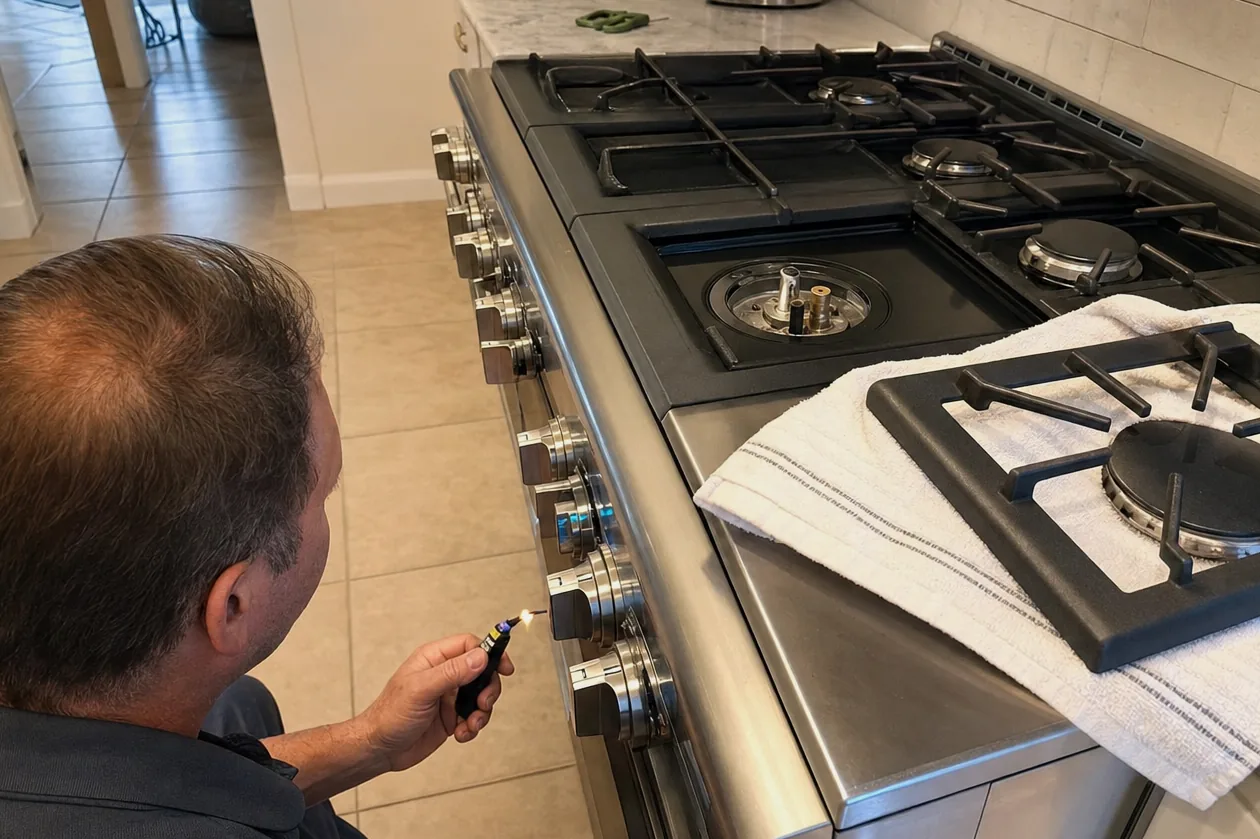
The clicking is the spark module doing its job. What has usually failed is downstream of it, and that is a much smaller repair.
Article
Why a burner clicks and will not light
One burner, whole cooktop
The single most common misunderstanding about gas cooktops is this: the spark module does not fire one electrode at a time. It fires every electrode on the manifold together, on every ignition attempt.
So when you turn on the front left burner and the entire cooktop starts ticking, that is not a fault. That is normal. The module is sparking all of them and only the one with gas flowing lights.
The consequence follows directly. If one electrode is shorted to ground, every ignition attempt on every burner bleeds through that short. The spark energy goes to the easy path instead of jumping the intended gap. The result is a cooktop where nothing lights properly and the owner concludes the whole ignition system is dead.
It is usually one electrode and a clean.
Why electrodes short
The electrode sits at the edge of the burner, at the exact height where boil-overs land. Sugar syrup, salted pasta water, tomato sauce and spray cleaner all leave a residue on the ceramic insulator. That residue is conductive when it is damp and often stays conductive when it dries.
The spark then takes the surface path across the wet ceramic down to the burner body, instead of jumping the air gap to the burner cap. You can often see it if you darken the kitchen: the spark appears at the base of the ceramic rather than at the tip.
Three sub-cases, in order of frequency:
Dirty. Clean the ceramic and the tip with a dry abrasive pad, get it properly dry, and it works. No parts.
Cracked. A hairline crack in the ceramic does the same thing permanently, and no amount of cleaning fixes it. Ceramic cracks from thermal shock, usually from cold water hitting a hot burner. This is a new electrode.
Misplaced cap. After cleaning, burner caps go back on rotated or not seated. The gap between electrode and cap changes and the spark cannot bridge it. Free fix, and a surprisingly common call.
When it sparks but still does not light
Different problem. Gas is not arriving where the spark is.
Check the burner ports. On a burner used heavily for years, the ports around the ring block with carbon and food residue and the flame cannot travel round the ring from the ignition point. A port cleaning restores it.
Check the orifice against the gas supply. This comes up on ranges that have been converted between natural gas and propane by somebody who did the conversion partially. An LP orifice on natural gas will not carry enough gas; a natural gas orifice on LP over-fires and roars. Both cause ignition problems, and the second one is a safety matter.
Check the safety valve if the burner has one. Some ovens and some burners hold the valve closed until a flame is proven. If the sensing element has failed, gas never flows regardless of how good the spark is.
Outdoors, it is grounding
An outdoor grill breaks this pattern. Indoors, ignition faults are usually the electrode. Outdoors, they are usually the ground path.
The spark needs a clean return through the burner body to the chassis. Salt air and moisture corrode the mounting bracket, and the return path goes high-resistance without anything looking wrong. The module clicks, the electrode looks perfect, and no spark appears. Cleaning up the ground connection is a five minute fix that people replace modules to avoid.
Isolating the fault yourself
If you want to narrow it down before calling, do it with the gas off at the appliance. Darken the room, turn a burner to the ignite position and watch where the spark actually appears at each electrode. The one sparking to its own base rather than to the cap is your problem burner. Tell us which one when you book and we will bring the right part.
Questions
Follow-ups
Is it safe to use the other burners while one keeps clicking?
The clicking itself is not dangerous, but a burner releasing gas without lighting is. If a burner is flowing gas and not igniting, shut it off and leave it off until it is repaired.
Can I light a burner with a match while I wait for the repair?
On most sealed burners you can, and people do. Turn the gas on at the burner only after the flame is at the port, not before, and never leave gas flowing while you look for a match.
Price Bands
What does a repair cost, band by band?
Parts and labour together, in the bands these jobs land in. The $80 diagnostic comes off the bill when you approve the work, and the firm figure is written down after the fault is proved.
| Work | Typical range |
|---|---|
| Diagnostic visit | $80 |
| Igniter or burner assembly | $200–$570 |
| Control board or touch panel | $390–$930 |
| Oven thermostat or heating element | $190–$550 |
If This Is Your Problem
The appliances this affects
Sealed burners, spark modules, oven temperature drift and the door hinges that carry a 40-pound door. 30, 36, 48 and 60 inch ranges, gas and dual fuel.
Drop-in rangetops in 30, 36, 48 and 60 inch widths. Burner and valve work, simmer faults, griddle and grill module repair, and the counter cut-out problems nobody warned you about.
Built-in and cart grills. Burner burn-through, igniter and valve failure, rotisserie motors, and the corrosion that coastal salt air puts into every fastener.
Keep Reading
Next article
Uniform offset, overshoot and sag, slow preheat and long-bake heat loss are four different faults with four different parts behind them. Separating them before quoting is most of the job.
Salt aerosol packs condenser fin stock, seizes fasteners and eats hinge pins. The symptoms mimic a refrigerant fault, which is how coastal owners end up quoted for sealed-system work they do not need.
Customer Comments
What customers said afterwards
4.8 out of 5, across 90 customer reviews. Every one is a single visit, in the words of the person whose kitchen it happened in.
The griddle section never came up to temperature and the burner under it roared. He found a cracked igniter and a warped baffle, changed both and reset the airflow. It cooks flat across the plate again.
Our range top would light on the left and not the right. He found the spark module burnt on one output and the ground strap loose under the chassis. Both put right, and he cleaned the burner ports while he had them off.
Next Step
Book a diagnostic
Give us the model number and what it is doing. We quote in writing before anything comes apart.
- $80 diagnostic, credited
- 90-day labor
- 365-day parts
- Mon-Fri 8am-6pm. Sat 9am-4pm. Closed Sunday.