One burner clicked constantly, even switched off. He found a cracked igniter letting damp across the electrode and replaced it. It stopped that minute. He also flagged a second igniter starting to craze.
Rangetops
Viking rangetop repair
Drop-in rangetops in 30, 36, 48 and 60 inch widths. Burner and valve work, simmer faults, griddle and grill module repair, and the counter cut-out problems nobody warned you about.
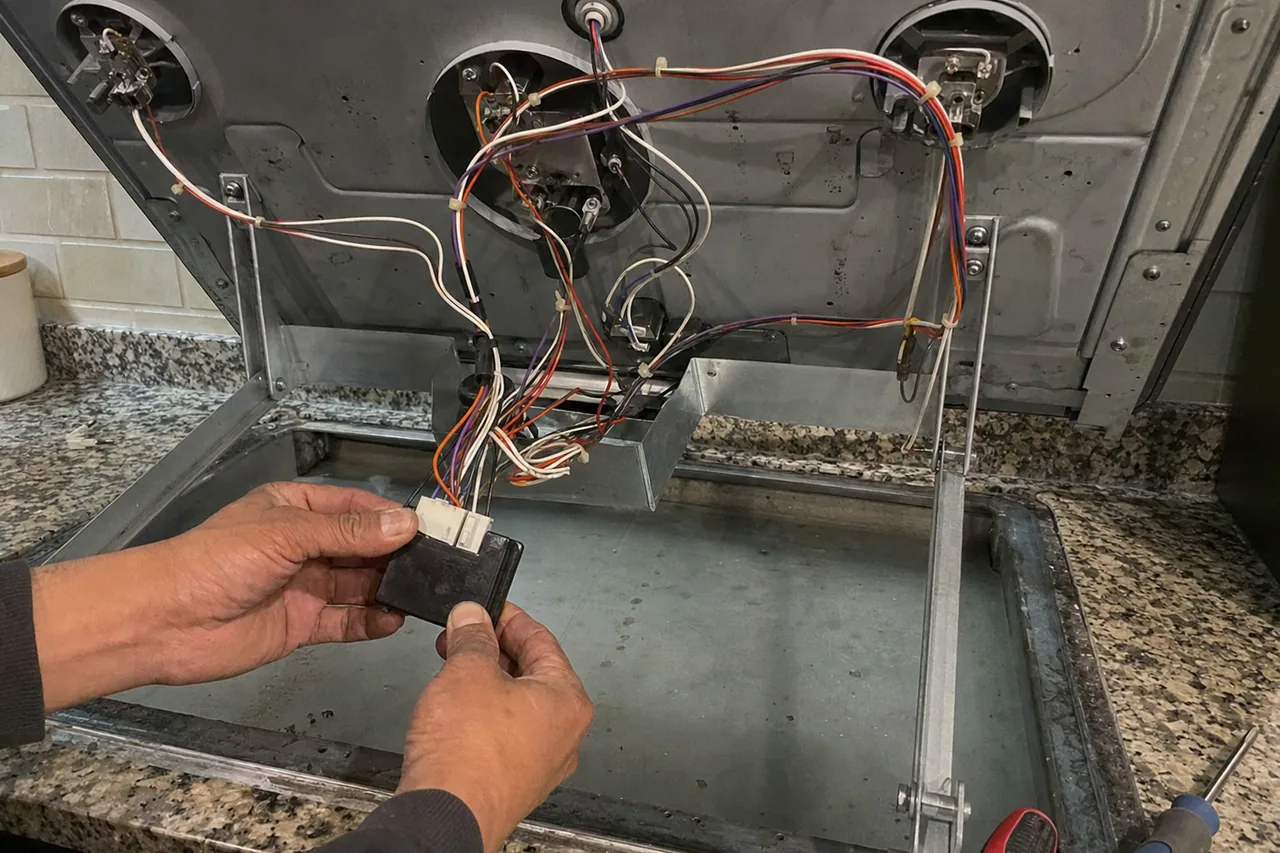
A rangetop is only serviceable once it is lifted. Everything that decides ignition lives in the few inches under this hinge.
Symptoms
What you are seeing, and what it usually is
Described from the owner's side. No invented error codes. Where the cause is not certain, what gets checked is listed rather than guessed at.
| Observed | Usually | The work |
|---|---|---|
| One burner lights, the rest only click | Spark module output is fine but a single electrode is shorting. The module fires the whole rail at once, so one bad electrode disguises itself as a whole-cooktop fault. | Disconnect electrodes one at a time to isolate, clean or replace the offender, re-gap and test each burner hot. |
| Flame lifts off the burner or roars | Air shutter or orifice mismatched to the gas supply, often after an LP conversion done by somebody else. | Verify the orifice size against the supply, reset the air adjustment, check manifold pressure at the test port. |
| Low setting goes out when the hood is on high | The hood is pulling the flame off a low simmer. Common on 48 and 60 inch installs with a high-capacity hood and no make-up air. | Confirm the burner is set correctly, then test with the hood staged down. Where it is a make-up air problem we say so rather than sell parts. |
| Griddle plate heats unevenly or scorches one end | Failed griddle thermostat or a burner underneath running lean. | Map the plate with a surface probe, check the thermostat against its calibration, replace what is out of range. |
| Grill module smokes badly or will not reach temperature | Grease-loaded radiants and a blocked burner, or a failed grill valve. | Strip and clean the radiants and burner, check gas pressure at the module, replace the valve if it will not modulate. |
| Knob is stiff, gritty or spins past the stop | Valve grease has dried out, or the stem is worn. Ten years of heat cycling drives the lubricant out. | Pull the manifold, re-grease serviceable valves with high-temperature valve grease, replace worn stems. |
Price Bands
What does a rangetops repair cost?
Parts and labour together, in the bands these jobs land in. The $80 diagnostic comes off the bill when you approve the work, and the firm figure is written down after the fault is proved.
| Work | Typical range |
|---|---|
| Diagnostic visit | $80 |
| Igniter or burner assembly | $200–$570 |
| Control board or touch panel | $390–$930 |
Detail
How we approach it
What a rangetop is, in service terms
A rangetop is the burner deck without the oven. It drops into a counter cut-out, the manifold and valves hang underneath in the cabinet, and every service job starts by getting into that cabinet. On a 48 or 60 inch unit with a griddle and a grill module, there is a lot of gas plumbing in a small space.
The advantage for the owner is that the two halves of a professional kitchen fail independently. The oven control board dying does not take the cooktop with it. The disadvantage is access, and access is where the time goes.
The faults we see most
Ignition, again. Same story as the ranges. One electrode shorting makes the whole rail spark continuously because the module fires every electrode together. Owners hear a cooktop-wide problem and expect a cooktop-wide bill. It is usually one electrode and a clean.
Simmer. The reason people buy this class of appliance is the low end, and the low end is what wears out. Viking calls its low-flame setting VariSimmer. When a burner will not hold that flame, the causes in order of frequency are blocked burner ports, an orifice that does not match the gas supply, and a valve that has lost its bypass setting. In that order. We check the free ones first.
Griddle and grill modules. These are the parts that live under a layer of grease. A grill module that will not get hot is usually choked rather than broken. A griddle that scorches at one end is usually a thermostat. Both are jobs where a proper strip-down is worth more than a part.
Valve feel. A knob that has gone gritty is a maintenance item, not a failure. The high-temperature grease in the valve dries out after years of heat cycles. Serviceable valves can be pulled, cleaned and re-greased. Sealed valves have to be replaced. We tell you which you have before quoting.
Hood interaction
A high-capacity hood over a 48 or 60 inch rangetop in a tight modern kitchen can physically pull a simmer flame out. If your low setting only dies when the hood is running on its top speed, that is an air problem, not a burner problem, and no part we could sell you would fix it. That is the kind of call where the diagnostic fee saves you money.
Getting to the manifold
Almost every rangetop repair that is not a surface part is a manifold repair, and reaching the manifold is what decides the visit. A rangetop drops into a countertop cut-out and sits on the counter, with the gas connection and the spark module underneath and, on most installs, a cabinet or a drawer bank below that.
That means the access route is from underneath and from the front, not from the back, and it means the drawers or the cabinet interior below the unit have to be clear before we arrive. Where a rangetop has been sealed to a stone countertop with silicone, that bead has to be cut and re-run afterwards, and we will say so before we start rather than after.
Age and parts
A rangetop has fewer parts to go obsolete than a full range, because there is no oven control in it. On many units the only electronics are the spark module, and spark modules stay available.
That makes older rangetops good candidates for repair. Burners, orifices, valves, electrodes, grates and griddle thermostats are commonly obtainable for units well over twenty years old, and none of them are difficult parts to fit once the manifold is accessible. We still check availability before quoting, but the answer out here is usually yes.
Terms
$80 flat diagnostic, credited to the repair. Written estimate first. 90 days labor, 365 days parts, genuine OEM parts. Independent shop, so the recommendation is ours and not a manufacturer’s.
Job Data
Scope and terms for this appliance
| Item | Detail |
|---|---|
| Widths serviced | 30, 36, 48 and 60 inch |
| Modules | Griddle, grill, wok and standard burner sections |
| Diagnostic | $80 |
| Labor warranty | 90 days |
| Parts warranty | 365 days |
| Access needed | Cabinet below the cut-out |
Questions
Asked on most of these calls
My rangetop is over a wall oven. Does that change the job?
It changes the access. A rangetop sitting above a built-in oven often leaves almost no room to reach the manifold. We plan for that on arrival and will tell you before we start if the oven has to come out.
Is a rangetop cheaper to repair than a full range?
Usually, because there is no oven cavity, no door hardware and no oven control to fail. The burner and valve work is the same money either way.
Is it worth repairing a cooktop, or is it time to replace it?
Almost always worth repairing. A rangetop is a manifold, a set of valves, burners and electrodes, and every one of those is an individual part. The band for that work on this page sits nowhere near what the machine costs new. The repair-or-replace page runs that division for every band we quote.
How much does it cost to repair a stovetop burner?
The flat diagnostic first, then the ignition and burner band above. A blocked port or a fouled electrode sits at the bottom of it. A burner that has taken its valve out with it sits at the top. Which of the two you have is what the diagnostic settles, in writing.
Can you fix a burner that only works on high?
That is normally the valve, not the burner. The low end of the valve travel is where the wear shows. We test the valve before quoting a part.
Related Appliances
Often the same call
$80 flat diagnostic, credited toward the repair. The diagnostic covers the visit, not the machine, so say so when you book if two are down.
Sealed burners, spark modules, oven temperature drift and the door hinges that carry a 40-pound door. 30, 36, 48 and 60 inch ranges, gas and dual fuel.
Wall, island and professional hoods with internal, inline or remote blowers. Motor and speed control faults, lighting, baffle and duct problems, make-up air diagnosis.
Single, double and combination wall ovens. Temperature drift, element and sensor faults, hinge and gasket wear, and control boards killed by power events.
Where This Comes Up
Areas where we see this most
Ranked by how far this appliance's failure pattern overlaps the housing stock, the exposure and the equipment age there. 40 miles by road of Fruit Cove, St. Johns County.
Reading
Background on this fault
Customer Comments
What customers said after a rangetops visit
4.8 out of 5, across 90 customer reviews. Every one is a single visit, in the words of the person whose kitchen it happened in.
The repair itself was sound, a spark module and a new electrode, and both burners work properly now. The first appointment was moved at short notice and nobody told us until we rang to ask.
The simmer plate never held a low flame under a sauce. He rebalanced the shutters, cleared two simmer ports and set the valve stop properly. It sits at a low flame now instead of dropping out.
Next Step
Book a diagnostic
Give us the model number and what it is doing. We quote in writing before anything comes apart.
- $80 diagnostic, credited
- 90-day labor
- 365-day parts
- Mon-Fri 8am-6pm. Sat 9am-4pm. Closed Sunday.