The hood roared and pulled almost nothing. He found the roof cap damper seized shut, freed and lubricated it, then measured the draw at the grille before and after so I could see the difference for myself.
Ventilation
Viking ventilation hood repair
Wall, island and professional hoods with internal, inline or remote blowers. Motor and speed control faults, lighting, baffle and duct problems, make-up air diagnosis.
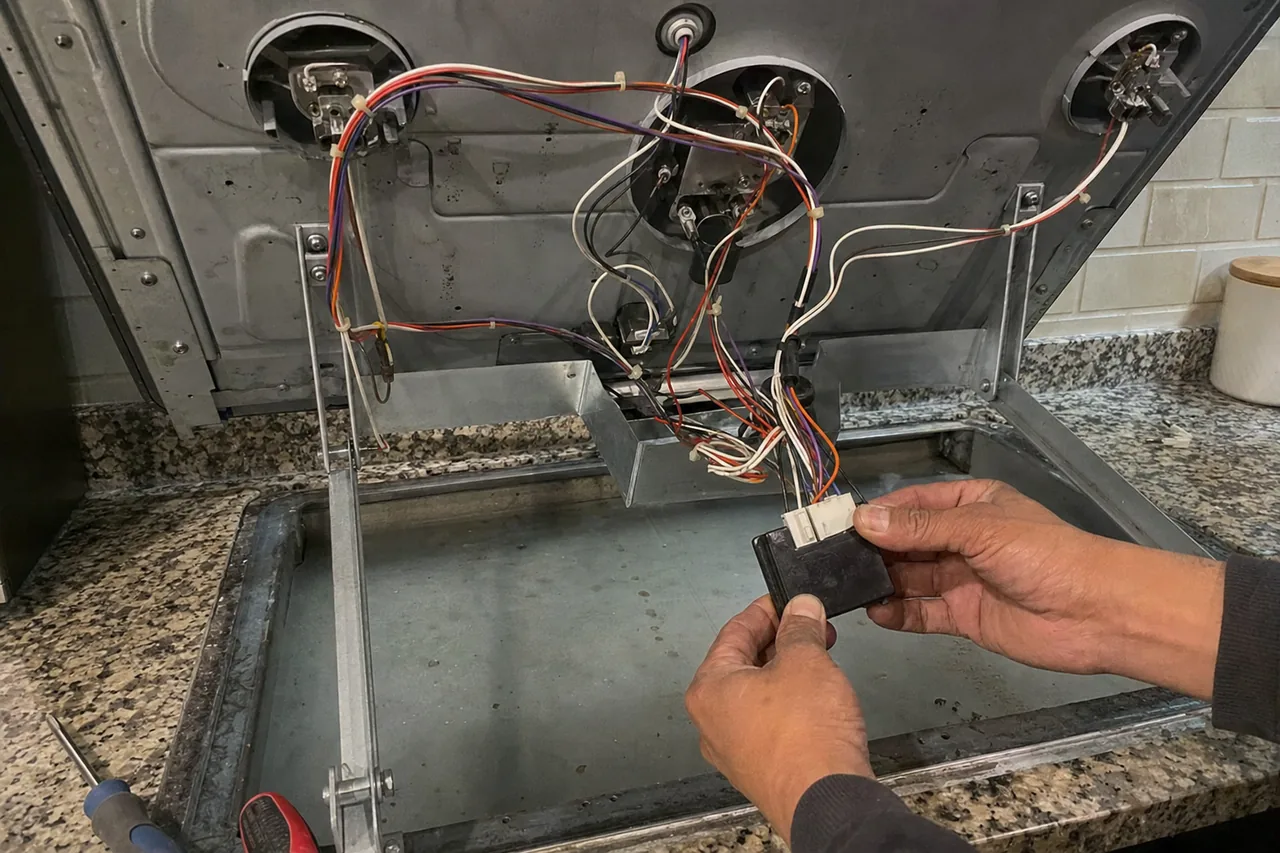
A hood is judged by the cooktop under it. Weak extraction is usually duct, damper or make-up air rather than the blower motor.
Symptoms
What you are seeing, and what it usually is
Described from the owner's side. No invented error codes. Where the cause is not certain, what gets checked is listed rather than guessed at.
| Observed | Usually | The work |
|---|---|---|
| Hood runs but pulls almost nothing | Grease-loaded baffles, a collapsed flexible duct, or a roof or wall cap whose damper is stuck shut. | Clean or replace baffles, inspect the full duct run, free or replace the cap damper, then measure again. |
| Blower hums but the wheel does not turn | Seized motor bearing or a failed run capacitor. | Test the capacitor, check the wheel for free rotation, replace the motor if the bearing is dry. |
| Only one speed works | Speed control board or a failed switch contact. Grease creeps into control housings on hoods without a proper baffle set. | Test the switch through its positions, inspect the control, replace what is dead. |
| Loud rattle or a rising whine at high speed | Unbalanced blower wheel, usually from baked-on grease on one side, or loose mounting hardware. | Pull and clean the wheel, check balance, re-torque the mounts and isolate any panel that is drumming. |
| Halogen or LED lamps dead in a bank | Transformer or driver failure rather than lamps. Banks go out together. | Test the driver output, replace the driver or the lamp module as the fault dictates. |
| Back-draught, or the hood kills a simmer flame | Too much extraction for a tight house with no make-up air. Common on 48 and 60 inch installs. | Measure what the hood is actually moving, check the make-up air provision, and report honestly. This is a building problem, not an appliance fault. |
Price Bands
What does a ventilation hoods repair cost?
A hood has one part in the price book below: its board. Motor, capacitor, speed switch, lighting driver and anything in the duct are quoted in writing once the fault is proved, and the duct and the make-up air are checked before a part is ordered. The $80 diagnostic comes off the bill when you approve the work, and the firm figure is written down after the fault is proved.
| Work | Typical range |
|---|---|
| Diagnostic visit | $80 |
| Control board or touch panel | $390–$930 |
Detail
How we approach it
A hood is three systems, not one
When a hood underperforms, the fault is in one of three places, and they need to be separated before anyone buys a part.
The appliance. Motor, capacitor, speed control, switches, lighting driver, baffles.
The duct. Everything between the hood collar and the outside air. Flexible duct that has been crushed behind a cabinet. A run with four elbows where the design allowed two. A roof or wall cap with a damper glued shut by years of grease.
The building. How much replacement air the house can supply. This is invisible on a work order and it is the cause of a large share of “my new hood does not work” calls in newer, tighter houses.
We check them in that order, and we tell you which one you have.
Grease is the mechanism
Baffles are not a filter in the sense of a mesh you throw away; they are a centrifugal separator. Grease hits the baffle, condenses and runs down into the trough. When the baffles are loaded, three things happen at once: extraction drops, grease passes through into the blower housing, and the blower wheel picks up an uneven coating that puts it out of balance. That unbalanced wheel is what you hear as a whine or a rattle at high speed.
Cleaning baffles monthly on a daily-use professional cooktop is the single highest-value maintenance job in the kitchen. It is also the one nobody does.
Make-up air, plainly
A 48 or 60 inch professional cooktop under a matching canopy can move a lot of air. A modern, tightly built house has very little leakage. Run the hood on full and the kitchen goes slightly negative, and air comes back in through the easiest available path. Sometimes that is a door whistling. Sometimes it is a simmer flame lying over and going out. Occasionally it is a gas water heater flue back-draughting. That is a safety matter, not appliance work: we say so on the spot, we do not touch it, and the hood stays untouched until it is dealt with.
None of that is a broken hood. If we find it, we say so and you keep your money.
Coastal installs
In the beach ZIPs, remote and roof-mounted blowers take salt aerosol year-round. Fasteners rust, damper hinges seize and motor housings corrode from the outside in. A hood that has lost its top speed in a coastal house very often has a damper that no longer opens fully rather than a tired motor.
Noise, and what it tells you
Owners report hood noise as one thing. It is at least three, and they are easy to tell apart.
A steady rush that has always been there is airflow, and it is proportional to how much air the hood is moving. Nothing wrong.
A whine or rattle that rises with speed and was not there last year is the blower wheel. Grease builds unevenly on the blades, the wheel goes out of balance, and the vibration finds every loose fastener in the housing. Pull the wheel, clean it properly, re-torque the mounts.
A low drumming from a panel is the hood body resonating, usually after somebody removed and refitted a filter rail or a liner. It is a fastener, not a motor, and it takes ten minutes.
Terms
$80 flat diagnostic, credited toward the repair. Written estimate before work. 90 days labor, 365 days parts, genuine OEM parts. Independent shop.
Job Data
Scope and terms for this appliance
| Item | Detail |
|---|---|
| Types serviced | Wall, island, under-cabinet and professional canopy |
| Blowers | Internal, inline and remote roof-mounted |
| Diagnostic | $80 |
| Labor warranty | 90 days |
| Parts warranty | 365 days |
| Roof blowers | Ground-level diagnosis first |
Questions
Asked on most of these calls
Why does my hood kill the simmer flame on my rangetop?
Because it is moving more air than the room can replace. In a well-sealed house a high-capacity hood will depressurise the kitchen and pull the flame off a low burner. The fix is make-up air, not a new burner.
Can you service a remote roof blower?
We diagnose from inside first, because most remote blower calls turn out to be the control, the wiring or the damper rather than the motor. Roof access is arranged separately and never in bad weather.
How often should baffles be cleaned?
Over a professional rangetop used daily, monthly in the dishwasher. Grease on the baffles is the single biggest cause of lost extraction and of unbalanced blower wheels.
You work on ducting. Does that mean you do HVAC?
No. The duct on this page is a kitchen duct: it starts at the hood collar and ends at a roof or wall cap, and it decides whether the hood pulls. Heating, air conditioning, air handlers and the ducting that moves conditioned air around a house are a different trade and we do not take that work.
Related Appliances
Often the same call
$80 flat diagnostic, credited toward the repair. The diagnostic covers the visit, not the machine, so say so when you book if two are down.
Drop-in rangetops in 30, 36, 48 and 60 inch widths. Burner and valve work, simmer faults, griddle and grill module repair, and the counter cut-out problems nobody warned you about.
Sealed burners, spark modules, oven temperature drift and the door hinges that carry a 40-pound door. 30, 36, 48 and 60 inch ranges, gas and dual fuel.
Built-in and cart grills. Burner burn-through, igniter and valve failure, rotisserie motors, and the corrosion that coastal salt air puts into every fastener.
Where This Comes Up
Areas where we see this most
Ranked by how far this appliance's failure pattern overlaps the housing stock, the exposure and the equipment age there. 40 miles by road of Fruit Cove, St. Johns County.
Reading
Background on this fault
Customer Comments
What customers said after a ventilation hoods visit
4.8 out of 5, across 90 customer reviews. Every one is a single visit, in the words of the person whose kitchen it happened in.
He replaced baffles that were well beyond cleaning, then checked the whole run out to the roof before quoting anything else. One section had been crushed flat behind a cabinet years ago.
The blower screamed on high. He balanced the wheel, found the mounting grommets had gone hard and perished, and replaced them. It is quieter now than I can remember it ever being.
Next Step
Book a diagnostic
Give us the model number and what it is doing. We quote in writing before anything comes apart.
- $80 diagnostic, credited
- 90-day labor
- 365-day parts
- Mon-Fri 8am-6pm. Sat 9am-4pm. Closed Sunday.