The griddle section never came up to temperature and the burner under it roared. He found a cracked igniter and a warped baffle, changed both and reset the airflow. It cooks flat across the plate again.
Electrical
Why appliances die the week after a storm
Surge damage is rarely instant. A board takes a hit, keeps working, and fails days later. Understanding that changes what a technician should test first and what protection is worth buying.
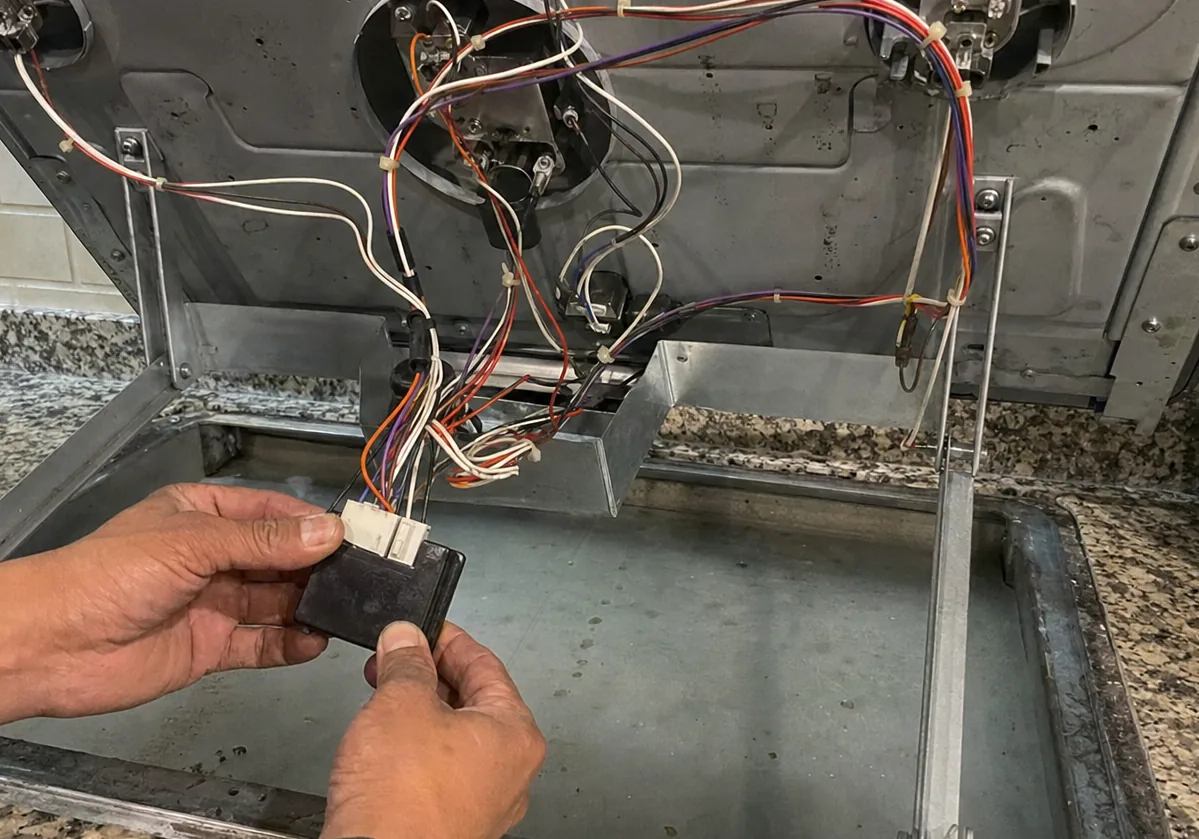
Boards seldom die in the storm anybody remembers. They die weeks later, and only a reading tells that from a coincidence.
Article
Why appliances die the week after a storm
The pattern
This metro sees roughly 68 thunderstorm days a year. That is a lot of afternoons where the grid takes hits, transformers trip, and voltage on a residential feed does things it is not supposed to do.
What owners expect is that an appliance either survives a storm or does not. What actually happens is a third thing: the board takes damage, keeps running, and fails somewhere between two days and three weeks later.
The mechanism is not mysterious. A transient stresses components that then run degraded. Electrolytic capacitors lose capacity. A power supply section that was regulating comfortably starts running hot. A relay contact welds partially. The board keeps functioning within tolerance until a normal thermal cycle pushes it over. Then the display goes dead, or a function stops working, and the storm is a fortnight in the past and nobody connects the two.
Why it matters for the diagnosis
It changes where a technician should start.
If you tell us the range went dead and nothing else happened, we work through the normal sequence. If you tell us the range went dead and there was a rough afternoon storm ten days ago, we start at the supply and the board, and we check whether anything else in the house is behaving oddly. Very often something is: a dishwasher that has lost a cycle, a wine cellar whose display is dark, a hood stuck on one speed.
That is one of the more useful things you can say when you book a call. It regularly saves a second visit.
What is on a modern kitchen’s board count
A professional kitchen is not one board, it is six or eight. Range or cooktop control. Oven control, sometimes two on a double. Dishwasher control. Refrigeration control, plus an ice maker module. Hood speed control. Wine cellar control. Built-in coffee system control.
A single bad event can take more than one, and the failures will not arrive together. That is the situation where panel-level surge protection stops being an optional extra.
What protection is worth buying
Panel-level surge protection. A device fitted at the service panel by an electrician, protecting everything downstream including hardwired appliances that cannot be plugged into a strip. This is the one that matters for kitchens. It costs less than one control board on a built-in refrigerator.
Point-of-use protection. Useful for plug-in equipment, and worthless for the hardwired range, the built-in oven and the hood, because they are not on a receptacle.
Nothing else. There is no magic appliance-level product. We do not sell surge protection of any kind and we recommend the panel-level device anyway, because we replace the boards it prevents.
Older houses, extra exposure
In Riverside, Avondale and Old Ortega, the mature tree canopy means limb strikes on distribution lines and more brief interruptions during a summer than a treeless newer development sees. Original electrical in those houses also frequently lacks a dedicated 20A counter circuit, so a kitchen ends up with shared loads and nuisance trips that get blamed on an appliance.
If you own a professional range in a 1920s kitchen, having an electrician look at the circuit is worth more than any part we could sell you.
What we do on the day
Confirm supply voltage at the appliance under load. Check the low-voltage rail on the board. Inspect for burnt traces, bulged capacitors and heat-discoloured components. If the board is dead, we tell you what a replacement costs before you commit, and on an older unit we check availability first, because there is no sense fitting mechanical parts to a machine whose board is unobtainable.
Questions
Follow-ups
Will a power strip protect my range?
A point-of-use strip protects what is plugged into it, and a hardwired range or built-in oven is not plugged into anything. Panel-level protection is the one that covers a whole kitchen.
Does homeowner insurance cover a surge-damaged appliance?
Sometimes, depending on the policy and the deductible. We write our findings plainly on the invoice so you have something usable if you decide to claim. We do not make any representation about your policy.
Price Bands
What does a repair cost, band by band?
Parts and labour together, in the bands these jobs land in. The $80 diagnostic comes off the bill when you approve the work, and the firm figure is written down after the fault is proved.
| Work | Typical range |
|---|---|
| Diagnostic visit | $80 |
| Control board or touch panel | $390–$930 |
| Igniter or burner assembly | $200–$570 |
| Oven thermostat or heating element | $190–$550 |
If This Is Your Problem
The appliances this affects
Sealed burners, spark modules, oven temperature drift and the door hinges that carry a 40-pound door. 30, 36, 48 and 60 inch ranges, gas and dual fuel.
Single, double and combination wall ovens. Temperature drift, element and sensor faults, hinge and gasket wear, and control boards killed by power events.
Panel-ready and stainless dishwashers. Drain and fill faults, heater and relay failures, blocked spray arms, door spring and cable wear, and boards after power events.
Undercounter and full-height wine storage. Temperature stability, dual-zone faults, condenser airflow in tight cabinets, door seals, and sealed-system diagnosis.
Where It Bites
Areas where this one matters most
These are the service-area pages that turn on this problem. Each one carries its own published figures rather than repeating this article.
Two different service problems in one city. Modern built-ins on the Southside, and 1900s to 1930s kitchens with undersized openings in Riverside, Avondale and Ortega.
Older housing near the river out to 2000s and 2010s building around Oakleaf. Access is rarely the obstacle here, so the work is proving which part actually failed.
The building here is recent and the installs are sound, so access is rarely the constraint. Power events and tightly built houses account for most of what we are called out for.
Building between US-17 and Doctors Lake is 1990s through 2010s, so appliances come out without cabinet work. Humidity and power events account for most of the calls.
Corrosion territory. Salt aerosol takes condensers, hinge pins and fasteners here, and the older beach houses put appliances in enclosures that were built around them.
Keep Reading
Next article
The three things that go wrong when a modern professional range meets a hundred-year-old kitchen: the opening is undersized, there is no dedicated 20A circuit, and the floor is no longer level.
Cabinet openings, countertop overhangs, rails, weight and the connections at the back decide how long a built-in repair takes. None of it is visible from the front, which is why we look at the installation before quoting.
Customer Comments
What customers said afterwards
4.8 out of 5, across 90 customer reviews. Every one is a single visit, in the words of the person whose kitchen it happened in.
A burner lit and then dropped out the moment the knob was released. He found a tired flame sensor and a loose spade connector behind the manifold, replaced one and remade the other, then tested the lot.
Our range top would light on the left and not the right. He found the spark module burnt on one output and the ground strap loose under the chassis. Both put right, and he cleaned the burner ports while he had them off.
Next Step
Book a diagnostic
Give us the model number and what it is doing. We quote in writing before anything comes apart.
- $80 diagnostic, credited
- 90-day labor
- 365-day parts
- Mon-Fri 8am-6pm. Sat 9am-4pm. Closed Sunday.